After 18 months in Morocco, I’ve finally set foot in a region I’ve always been curious about: the Rif mountains along Morocco’s Mediterranean coast.
I’ve left behind the now fairly routine rhythm of fieldwork in pursuit of a few days of relaxation. Unable to settle on another good yet economically modest holiday destination (and limited by the Icelandic cloud of ash that obstinately continues to paralyze airway traffic), I managed to convince Farid, my good friend and colleague, to take me north, to his native land.
And so here we are, ensconced in the heart of the legendary Rif. We’re taking day trips west to Al Hoceima, and longer ones east, to Temsamane, Anoual, Nador and Oujda. Other than that we spend most of our days in Beni Bouayach, a small village east of Al Hoceima. It was built only recently, but now serves as a business epicenter of sorts for a number of smaller villages in the surrounding hills. Their dirt roads now meet up on the new main street of this town: a busy, café-lined thoroughfare for tractors and trucks, donkey carts and regional taxis (here painted in a greenish turquoise, in reflection perhaps of the nearby Mediterranean).
The area is full of history, and family trees – centuries old, yet still blooming – are rooted deeply and firmly in its soil. It awakens in my own quite rootless existence a nostalgia for a feeling I’ve never quite had. Each hillside hides a story; each valley is the stage for a family saga. Most of these stories are colored by a theme of opposition against outside forces. The Rif Berbers have long been proud resisters of submission to centralized control, and make subtle claims to separate-ness on a daily basis. It is, first and foremost, a separateness borne by language. The people in this region understand Moroccan Arabic, but their language is Tariffit, and as a matter of principle, they prefer not to speak what they consider the language of the occupier. So as not to grate against local ears, I resort to Arabic only for the most essential communication, but otherwise rely on Farid’s expertise as interpreter.
My own communicative efforts have thereby been reduced to a minimum; as such, the mental complexity of my daily life has been dialed back to a primordial level of simplicity. With my fieldwork in Rabat being so heavily dependent on human interaction, this brief period of virtual deaf/muteness has actually been a welcome respite from my regular life, and amplifies my sense of really being ‘away’. Without that mental exertion directed outward, I’ve been able to focus on turning inward. I’ve had time to think, to process, to formulate new directions for my research. And for the first time in what feels like months, I’m finding time to write again – something other than field notes, that is.
I’ve never spent this much time in a Moroccan village this small, and I adore the snapshots that I am being given of daily life in this region. Traipsing through fields of wheat, groves of olive trees, and patches of coriander plants, making sure everything is growing as it should. Checking the level of water in the well – it’s been flowing generously ever since the earthquake of 2004. Looking in on the presses where, come December, olives will be converted into olive oil. Eating apricots straight from the tree. Bringing bread and fruit to community members in need. Taking lunch to the imam after Friday prayers. Shopping at the market, where you can pick out your own live chicken for slaughter. Whiling away evenings in plastic chairs on the sidewalk, chatting about future prospects over mint tea and sunflower seeds. And spending the occasional night hidden away on a rooftop, furtively drinking wine and whiskey.
The latter, I must qualify, are activities distinctly reserved for men. Women generally do not show themselves outside after dark. In fact, the foundational principle of Riffi social organization seems to be that the family’s women are to be protected from the gaze of strangers’ eyes. I am told that Riffi families place great value on privacy. Life in a city apartment is unacceptable: they could never share a hallway, even a front door, with strangers. All families here thus live in the Moroccan equivalent of townhouses. The entire village is made up of them: boxlike constructions, three floors high, with colorful plasterwork facades. The ground floor provides space for a garage, or even a store; the two floors above are each outfitted as fully functional apartments, including salon, kitchen, and bathroom. This is local logic: with what essentially constitutes two separate apartments for each family, men and women can entertain separately. Male and female worlds seem in fact to constitute parallel, but completely separate domains; beyond the private realm of the immediate family, there is very little informal mixing. Even weddings are single-sex affairs.
As a foreigner and outsider I am exempted from these standards of propriety, and so I get to be there for the nightly tea or wine. But being the only woman who shows herself outside after dark, I am nevertheless an anomaly. And being a blonde woman, I’m an anomaly about which people draw particular conclusions. Farid explained it to me as follows. As we drove onto the main street of Beni Bouayach, he informed me that to those who don’t know him well, the sight of us together will lead to the assumption that he has “found one” – that is, that he’s managed to find himself a European woman who will marry him for ‘papers’.
Departure is a common wish, a shared dream, a notion ever-present. There is common agreement among the people of this region that opportunity – fortune, career, a future – lies beyond. Regardless of how far the beyond on which one has set one’s sights, young adults all feel that there is little for them here among these hills. They’ve grown up with fathers, uncles, older cousins away in northern Europe, and these migrants’ stories have nourished the next generation’s dreams of leaving. Each summer, visiting emigrants’ display of European wealth and worldliness further widens the chasm between reality and desire. For the young men of this region, stunted in their masculinity and adulthood, a woman from the West can – literally – be one’s passport for departure.
For me, in turn, this region illustrates the sadness of stifled potential. The people’s stories of lack and limitation strikingly contradict the beauty of these hills, their obvious fertility. But this contradiction is born not so much of misperception; it emerges rather from the problematic relationship between the Rif and the central government. In a vicious cycle of cause and consequence, the Rif Berbers have always resisted submission to centralized power, and the government has, in subtle and not so subtle ways, consistently and systematically neglected this region. The tribes here are fiercely independent-minded, and always at the ready to fight for their autonomy. This volatile combination has helped Morocco battle for its sovereignty in the past (against the Ottomans, then the Europeans), but now poses what is perhaps the greatest threat to the power of the monarchy. A threat the government attempts to contain through isolation. This is a forgotten corner of Morocco: roads are in dangerous disrepair, there is a dire lack of schools for higher education, and no irrigation systems at all. After an earthquake devastated the region in 2004, the government failed tragically to help re-build. Internet connections are twice as slow as anywhere else, and radios receive more Spanish than domestic channels.
Apart from neglect, there is also silence. The region’s colorful and volatile past – battles, victories, independence and subjugation – has systematically been left out of the Moroccan history books. To the people themselves, stories of oppression are often too shameful to recount. This new generation of stunted young men has thus, sadly, grown up ignorant of its people’s illustrious past, of the sagas that link them to this ground. They are unaware of their rootedness – laboring under a sense of lightness, perhaps, that further nourishes their dreams of a beyond?
Without government investment, the community around Beni Bouayach has become surprisingly self-sufficient. Community funds (much of it from emigrants in Europe) have financed the installation of electricity, the construction of new housing, and the charity that cares for those who are less fortunate. Without government investment the community is, unfortunately, not (yet?) able to create long-term opportunity for its people. But their pride nevertheless refuses to be stunted. The people find subtle, daily ways of resisting subjugation. Their language is alive and vibrant; used often use to tell jokes at the expense of Arabs, or to grunt at the presence of “er makhzen,” the government.
Yet, lest we forget that even this remote and neglected corner of the country still bows under the rule of its King, the government has nevertheless managed to put its stamp on the region. Frequent displays of the Moroccan flag and portraits of Mohammed VI help to remind us that the notion of a Rif Republic remains but a mere nostalgic idea…
Showing posts with label norms and values. Show all posts
Showing posts with label norms and values. Show all posts
Wednesday, May 19, 2010

Monday, November 9, 2009
Things to Do in Rabat on a Saturday Night
Last Saturday night, I believe temporarily forgot that I was in Morocco.
Around seven PM, I met up with a group of NIMAR-affiliated ladies downtown. After a pleasant dinner at Le Petit Beur, a small restaurant close to the Parliament, we headed over to Théatre Mohammed V for “ABBA the Show,” a big spectacle, as the Théatre always calls it, of classic ABBA songs put on by a sizeable and very enthusiastic ABBA cover band. Complete with lighting effects, original ABBA members and 1970s costumes, the show was fabulously entertaining. The theater was packed with fans screaming and singing aloud so fervently that one would have thought the original singers were up there on stage. Had it not been for subtle references to Morocco through the lighting effects (a ‘DH’ sign lighting up on the stage backdrop amidst Euro and Dollar symbols during the song Money, Money, Money; a collection of red and green lights creating an image of the Moroccan flag at the end of the show – and sending the crowd into ecstasy), the entire ambience would have made me forget where I was.
The Théatre National Mohammed V is one of Rabat’s primary theater venues. It offers a wide variety of entertainment to the Rbati public, from plays in Moroccan dialect to Flamenco concerts and hip hop dance performances – to quote a few offers from the upcoming winter program. But those who seek to spend a soirée out on the town have more than just this theater to choose from. The various cultural institutes scattered around the city center (The German Goethe Institut, the Spanish Instituto Cervantes, and the Institut Français, for instance) each offer their own selection of music, films, and other performances around town. The result is a weekly offer of cultural activities that will certainly not leave you wanting for entertainment.
You might start your cultural evening out at one of Rabat’s many decent restaurants – in one’s choice of price range and cuisine – and end it at a swanky bar or nightclub. For contrary to what one might think about a country where alcohol is prohibited by law to 99% of the population, nightlife in Morocco’s larger cities is alive and thriving. The offer of venues runs the full gamut from dark and dingy dive bars, where the only women present are there in a professional capacity, to hip and trendy nightclubs. The latter are places to see and be seen. Dressed to the nines, groups of men and women lounge around the table they’ve reserved, making their own drinks from the bottle of alcohol they’ve purchased and the mixers – coke, sprite – they’ve been given for free. They laugh, chat, and occasionally dance – first to American hip hop, later to the techno and house that follow it. Girls wear revealing tops and skinny jeans; boys wear shiny fitted shirts and leather shoes. There is an ease of interaction between the sexes that seems to contrast with daytime social conventions.
Whenever I am out, whether it be at the theater or at a club, I cannot help but wonder about the identity of the people I see around me. Who frequents these places – from what socio-economic background do they originate? The nightclubs I have seen are a swanky affair. There seems to be an elitism to the whole experience, a suggestion of luxury; the advertisement of a certain level of wealth and a certain brand of modernity. It’s in the way people dress – the glitter, the brand names – but it’s also in the money one ostensibly spends for a night of dancing. The cover charge for Amnesia, one of Rabat’s most famous clubs, is 200 Dirhams – a small fortune, if you imagine that a large proportion of the Moroccan population lives on a salary of 1500 a month or less. Admission comes with a free drink, but any subsequent beverage runs at least 80 Dirhams.
However, my friend Hatim tells me that the real regulars never pay. The secret, he tells me, is to get to know the bouncer. To strike a deal, and get a discount. It’s not the upper classes that one will encounter at the club, he explained – those elites have their own, private, establishments. No, the trendy patrons at Amnesia are individuals just like you and me; they’ve just managed to bargain their way inside, to an evening of luxury at a discount price. Once again, the suggestion emerges that everything in Morocco is negotiable, and nothing is as simple as it seems (… but the true elite always remains out of reach).
Yet my question remains. Who, then, frequents places like Amnesia? Where do they come from, and where do they live? What kind of jobs do they hold, where do they go to school, and how does their behavior at the club fit into their daytime social roles?
When thinking about these questions I often catch myself imagining each of these nameless young individuals to be a kind of Jekyll-and-Hyde – possessors of a nighttime alter ego whose behavior is incommensurable with their daytime identity. I’m intrigued by the contrast that seems to exist between the social conventions of Moroccan society, and the vibe I encounter at these clubs. On this blog, I often write about the various ways in which ‘tradition’ is idealized and upheld by Moroccan society, and the ways in which particular interpretations of ‘modernity’ emerge and interact with old customs and conventions. I’m interested in the ways in which these two concepts seem, ostensibly, to contradict one another. And so I take note of the way in which I see girls dress and behave at Amnesia – and then contrast it with the grumpy man Fatima and I once encountered as we walked home at 3 AM, who asked my friend if her mother knew she was out so late, and then added that she must be a prostitute.
But if there is one thing I have learned about Morocco, it is that nothing is ever as simple as it seems. ‘Modernity’ and ‘tradition’ are not entities but ideas with very fluid boundaries. They are not polar opposites but rather converging and diverging ideologies about the meaning of our socio-cultural rules and conventions. We all live lives that combine elements of the modern with notions of tradition, and this need not make us Jekyll-and-Hydes, unless we ourselves allow it to. So, too, for the men and women I see at Amnesia. Because in the end, what is so strange about a girl who dances in an outfit she’d never wear to work, or a boy who purchases more alcohol than he’d ever admit to his parents? Don’t we all behave a little more freely under the cover of dimmed lighting, thumping beats, and a bit of alcohol?
Thursday, August 20, 2009
The Moudawana, Five Years Later
The New York Times published an article today about the status of women in Morocco, five years after the radical reforms of the Moudawana (the Family Code of Law) came into effect. This article is the latest in a small collection of others published about the same issue, and largely presents the same conclusion: while great headway has been made toward elevating the status of women in Morocco, much remains to be desired.
The articles’ authors note a discrepancy between imposed law and applied reality, and mention that the legal changes made are not far-reaching enough: women still inherit only half of what men do, for instance, and single mothers still have no legal rights. More reforms are needed, they therefore argue.
As much as it is true that the new body of Family laws leaves certain issues unchanged, I agree with those who think that the disparity between the law and its real-life application is a more pressing issue that needs to be dealt with, before we start talking about further reforms. Five years after the new laws came into effect, issues continue to plague their mise en pratique. Because the new code of law was not accompanied by sufficient efforts to re-train Morocco’s legislative body, judges and courts were mostly left to figure out how to apply the new procedures on their own. Divorce procedures, marriage contracts, applications for citizenship, and custody battles therefore continue to be plagued by legal inconsistency and uncertainty.*
Likewise, efforts to educate the public remained insufficient. Of course, the means to create awareness are limited, among a public with a high rate of illiteracy. But the result is that many – both men and women – have little sense of what the new laws really entail. And in that sense, the failure of the Moudawana to unambiguously live up to its promise of radical change points to deeper issues that plague Moroccan society.
First of all, the insufficient efforts at public education reveal (and probably reinforce) another dimension of the big divide between center and margin in Morocco. The new law was passed by the parliament in Rabat. Its written form, as well as those publications that discuss it, are accessible to and read by the educated citizens of Morocco’s larger cities. Francophone women’s magazines make an effort to answer readers’ questions about what has legally changed. But very little of it all penetrates the margins – by which I mean both those geographical areas far removed from the epicenter of government, as well as those communities far removed from any sense of power, through lack of money and lack of education. The result? Those women who stand to gain the most from these new laws – impoverished, uneducated, illiterate women in rural regions – are the least aware of their new rights, and continue their lives much as they used to. And how can you effect real, applied, change, when it impacts only a small proportion of the population? There is very little point in enforcing change from the top, if it is not accompanied by an effort to reach down toward the public, to help it understand the new legislation and facilitate its real-life implementation.
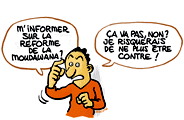
(This cartoon appeared in TelQuel, the francophone Moroccan version of Time or Newsweek. The dialogue translates into "Informing myself about the Moudawana reform? That's a bad idea, I might no longer be against it!")
In a more general sense, I think that the lack of education and awareness also makes that the general public (urban as well as rural) does not know what to make or think of the reformed Moudawana. With only a vague sense of what the new laws really stipulate, many see the new code mostly as a dangerous threat to traditional values and social order.** Originally pushed for by feminist movements and other liberal progressive groups, the new laws are seen as representing the victory of modernizing and secularizing tendencies in Morocco. The entire issue of Family Code reform thereby remains stuck in (and representative of) the deadlocked debate-turned-struggle between ‘tradition’ and ‘modernity’, and inspires fear and hostility in those who perceive it as a threat to their conservatism.
The new Moudawana is both cause and result of a shift in the foundations of Moroccan society. Government efforts at socio-economic development, modernization, and globalization have occasioned an intensive and sometimes highly emotional debate about the relative value of tradition and modernity. Within that debate, these two concepts, or better said, ideologies, are often starkly opposed to one another. Each has its adherents, and each of these two camps is so worried about the dire impact of the other’s dominance, that neither is prepared to make any compromises on its ideals. The result is a deadlocked debate in which ‘tradition’ is portrayed as the polar opposite of ‘modernity’, and open communication seems to get a bit lost. As much as the King attempted to involve representatives of all ideologies and sympathies in the drafting of a new law, the reforms of the Moudawana are mostly seen as the triumph of modernity and secularism – and many conservatives and Islamists felt (and feel) disenfranchised, overruled, or ignored.
As much as, again, I agree that additional changes must be made, I also think that radical reform simply may not always be the most effective way to push for change. Not if it creates hostility and thus throws up barriers that hinder effective communication and collaboration. People don’t like change, even if it’s inevitable. Sometimes, it is much more efficient to be patient, take it slow, make an effort not to completely do away with the past, and ease into a new status quo. It makes those resistant to change feel validated in their concerns. Pushing too hard, too fast, only incites greater conflict and protest.
Yes, there is a ways yet to go toward equalizing women’s status. But right now, I think that what is holding it back has less to do with legal rights than it does with public opinion. Radical legal reform is not necessarily effective if it gets too far ahead of the public mind.*** There is no point in adding new laws to ensure women’s equal share of inheritance, if women in rural areas have not even become able to claim their right to divorce. This does not mean that we should give up on change. But it does mean a greater openness to conservatives’ sentiments, individuals’ fears, a greater effort to find a middle ground between different ideological desires, attempts to ease into change at a pace that is comfortable for everyone – and a willingness to make other social changes that make the implementation of new family laws a bit easier (combating illiteracy and corruption, perhaps?). An effort, simply, not to make a large proportion of society feel disenfranchised and brushed aside. Do this, and perhaps you’ll find much more goodwill and openness to real, meaningful dialogue about the future of society and the place of women in it.
In order for this dialogue to take place, greater openness is needed, as well as a greater and more systemic effort at public education about what these new laws really imply: how they relate to Islam (how they may coexist peacefully with religious values), what their impact will be on the structure of the family, and how it affects the status of men. Fears and concerns must be openly and respectfully addressed. Only then can the population begin to process the changes that have been made – and only once that has been done, is it going to be useful to begin discussing additional reforms.
* add to that the persistent and widespread problem of corruption…
** Yes, of course, the new Moudawana does make a lot of changes to the traditional status quo. But I think that there may be more room for a continuation of traditional values within the new legal situation than many people assume.
*** I do not think this is always true, in every situation. There are times and places when radical reform is necessary. But within the context of a deadlocked societal debate between two camps with equal power, it simply doesn’t serve anyone to make half the population feel disenfranchised. No matter how wrong you may think that other half is.
The articles’ authors note a discrepancy between imposed law and applied reality, and mention that the legal changes made are not far-reaching enough: women still inherit only half of what men do, for instance, and single mothers still have no legal rights. More reforms are needed, they therefore argue.
As much as it is true that the new body of Family laws leaves certain issues unchanged, I agree with those who think that the disparity between the law and its real-life application is a more pressing issue that needs to be dealt with, before we start talking about further reforms. Five years after the new laws came into effect, issues continue to plague their mise en pratique. Because the new code of law was not accompanied by sufficient efforts to re-train Morocco’s legislative body, judges and courts were mostly left to figure out how to apply the new procedures on their own. Divorce procedures, marriage contracts, applications for citizenship, and custody battles therefore continue to be plagued by legal inconsistency and uncertainty.*
Likewise, efforts to educate the public remained insufficient. Of course, the means to create awareness are limited, among a public with a high rate of illiteracy. But the result is that many – both men and women – have little sense of what the new laws really entail. And in that sense, the failure of the Moudawana to unambiguously live up to its promise of radical change points to deeper issues that plague Moroccan society.
First of all, the insufficient efforts at public education reveal (and probably reinforce) another dimension of the big divide between center and margin in Morocco. The new law was passed by the parliament in Rabat. Its written form, as well as those publications that discuss it, are accessible to and read by the educated citizens of Morocco’s larger cities. Francophone women’s magazines make an effort to answer readers’ questions about what has legally changed. But very little of it all penetrates the margins – by which I mean both those geographical areas far removed from the epicenter of government, as well as those communities far removed from any sense of power, through lack of money and lack of education. The result? Those women who stand to gain the most from these new laws – impoverished, uneducated, illiterate women in rural regions – are the least aware of their new rights, and continue their lives much as they used to. And how can you effect real, applied, change, when it impacts only a small proportion of the population? There is very little point in enforcing change from the top, if it is not accompanied by an effort to reach down toward the public, to help it understand the new legislation and facilitate its real-life implementation.

(This cartoon appeared in TelQuel, the francophone Moroccan version of Time or Newsweek. The dialogue translates into "Informing myself about the Moudawana reform? That's a bad idea, I might no longer be against it!")
In a more general sense, I think that the lack of education and awareness also makes that the general public (urban as well as rural) does not know what to make or think of the reformed Moudawana. With only a vague sense of what the new laws really stipulate, many see the new code mostly as a dangerous threat to traditional values and social order.** Originally pushed for by feminist movements and other liberal progressive groups, the new laws are seen as representing the victory of modernizing and secularizing tendencies in Morocco. The entire issue of Family Code reform thereby remains stuck in (and representative of) the deadlocked debate-turned-struggle between ‘tradition’ and ‘modernity’, and inspires fear and hostility in those who perceive it as a threat to their conservatism.
The new Moudawana is both cause and result of a shift in the foundations of Moroccan society. Government efforts at socio-economic development, modernization, and globalization have occasioned an intensive and sometimes highly emotional debate about the relative value of tradition and modernity. Within that debate, these two concepts, or better said, ideologies, are often starkly opposed to one another. Each has its adherents, and each of these two camps is so worried about the dire impact of the other’s dominance, that neither is prepared to make any compromises on its ideals. The result is a deadlocked debate in which ‘tradition’ is portrayed as the polar opposite of ‘modernity’, and open communication seems to get a bit lost. As much as the King attempted to involve representatives of all ideologies and sympathies in the drafting of a new law, the reforms of the Moudawana are mostly seen as the triumph of modernity and secularism – and many conservatives and Islamists felt (and feel) disenfranchised, overruled, or ignored.
As much as, again, I agree that additional changes must be made, I also think that radical reform simply may not always be the most effective way to push for change. Not if it creates hostility and thus throws up barriers that hinder effective communication and collaboration. People don’t like change, even if it’s inevitable. Sometimes, it is much more efficient to be patient, take it slow, make an effort not to completely do away with the past, and ease into a new status quo. It makes those resistant to change feel validated in their concerns. Pushing too hard, too fast, only incites greater conflict and protest.
Yes, there is a ways yet to go toward equalizing women’s status. But right now, I think that what is holding it back has less to do with legal rights than it does with public opinion. Radical legal reform is not necessarily effective if it gets too far ahead of the public mind.*** There is no point in adding new laws to ensure women’s equal share of inheritance, if women in rural areas have not even become able to claim their right to divorce. This does not mean that we should give up on change. But it does mean a greater openness to conservatives’ sentiments, individuals’ fears, a greater effort to find a middle ground between different ideological desires, attempts to ease into change at a pace that is comfortable for everyone – and a willingness to make other social changes that make the implementation of new family laws a bit easier (combating illiteracy and corruption, perhaps?). An effort, simply, not to make a large proportion of society feel disenfranchised and brushed aside. Do this, and perhaps you’ll find much more goodwill and openness to real, meaningful dialogue about the future of society and the place of women in it.
In order for this dialogue to take place, greater openness is needed, as well as a greater and more systemic effort at public education about what these new laws really imply: how they relate to Islam (how they may coexist peacefully with religious values), what their impact will be on the structure of the family, and how it affects the status of men. Fears and concerns must be openly and respectfully addressed. Only then can the population begin to process the changes that have been made – and only once that has been done, is it going to be useful to begin discussing additional reforms.
* add to that the persistent and widespread problem of corruption…
** Yes, of course, the new Moudawana does make a lot of changes to the traditional status quo. But I think that there may be more room for a continuation of traditional values within the new legal situation than many people assume.
*** I do not think this is always true, in every situation. There are times and places when radical reform is necessary. But within the context of a deadlocked societal debate between two camps with equal power, it simply doesn’t serve anyone to make half the population feel disenfranchised. No matter how wrong you may think that other half is.
Saturday, December 13, 2008
Acceptable... or Not?
One theme that has colored my experience of the past three months in Morocco, is my sense that the relationships between genders seem a lot more free, and a lot less rigidly controlled, than I had always thought. I see mixed groups of friends on the street every day, boys and girls holding hands, touching each other in the way that friends here do, kissing one another on the cheek with each greeting – and all this without any kind of sexual undertone. I still pretend to be completely deaf when addressed by random men on the street, but have noticed also that the occasional brief conversation when waiting in line somewhere, or browsing at a store, is completely acceptable.
Seeing all this flexibility around me, I have been opening myself up a little more. I don’t approach anyone myself, but if someone addresses me on the train when sitting across from me, or asks me a question at a café, I smile and politely respond.
This has happened a few times at a particular café I like to go to. Close to the central train station, this particular café with a Scandinavian name is a very pleasant and comfortable place to sit for women by themselves (which, despite much social change in Morocco, is still uncommon. Cafés remain men’s territory). And most importantly, it has a wireless internet connection. I like to sit at this café during late afternoons, as it gets dark and cold outside, and sip a cup of “café crème” (café au lait) as I write emails, compose new blog posts, read the news, and watch my favorite American television shows on Youtube.
One thing I like about this café is the sense of calm and privacy I have here. There are people and noises all around me, but I am left alone with my computer, I get to drink whatever I want, and there is no one to bother me, to tell me how to do something. Once in a while someone will approach me. This is not something I mind, and it is usually no more than a brief question – usually it is a girl with a flash drive but no computer, who asks me to help her check whether or not she has a certain document on her little portable storage item. Sure, I always say, as long as there’s no virus on that drive…
The other night, two young men sitting at the table next to mine asked me a question about my computer. What kind was it? “Ash pay?” (this refers to HP, Hewlett Packard, which I think is the most well-known brand of computers here). Apples are not well-known here, and I get a lot of compliments on my little sleek, white laptop. The name “apple” didn’t ring a bell with these two men, but “macintosh” did. Yes, they knew it, good computers for designers.
From this, we launched into a polite discussion about what we were all doing in Rabat, and how I liked Morocco. As always, there was the immediate invitation to come visit families in other cities – to this I always politely respond with “insha’llah” – ‘God willing’, which is a great way of neither impolitely refusing, nor making false promises. None of this exchange was unpleasant – they were respectful, left me my space, and politely said good-bye when it was time for me to go and meet up with a friend in Agdal.
I had just been thinking that I had now clearly proved to myself that social contact between genders was thus not as restricted as I had presumed, when I returned to the café the next day and the owner approached me. The waitress (who now knows me so well that I don’t even have to ask for my café crème anymore) had told him what had ‘happened’ last night, and he wanted me to know that he was sorry. He wanted this to be a safe space for people to do their work, he said, and men were not supposed to be ‘bothering’ women sitting by themselves. A little taken aback, I tried to tell him that really, it hadn’t been a big deal – but this was not what he wanted to hear. No, he said, it’s not ok. He assured me he had talked to the two boys in question, who had both apologized. I decided it would be best to thank him. This I did, and a smile of relief came over him. Don’t worry, he said, it won’t happen again.
Left with that reassurance, I sat down at a table, sipped the café crème I no longer have to ask for, and was re-enveloped by a bit of confusion. What exactly had made my exchange from the night before so unacceptable? Did I do anything I shouldn't have? If this wasn't, what, then, is acceptable?
Tuesday, December 2, 2008
Hshouma Culture
My indignant host sister, Manal, uses the word “hshouma” at least thirty times a day. She often uses it to accuse others: “hshouma ‘alik!” or “hshouma ‘alikoum!” At other times she uses the word more generally – any number of issues that are talked about between the members of my host family will be deemed “hshouma.”
Manal is not the only one; “hshouma” is a frequently used word in Moroccan society. In its most general translation, “hshouma” means ‘shame’, and the word is attached, basically, to anything that does or would go against social and cultural convention. You can say this about things others have done: A guest was received at a house but not given anything to drink? Hshouma ‘alihoum – shame on the hosts! A girl and boy were kissing on the street? Hshouma ‘alihoum! Someone wore his outdoor shoes into the hammam? Hshouma ‘alih! And so on.
Alternatively, you can use it to explain how certain things must be done. Serve guests only water because you only have a little tea left? No, impossible, hshouma. Walk outside in your underwear? No, impossible – hshouma. Keep your last extra blanket for yourself rather than give it to someone else? No, impossible – hshouma. You get the picture.
Hshouma is a strong word, and (despite the fact that I hear it so often) I am told not to use it too frequently. If bothered on the street, for instance, it is best to stick to “ihtaram rasek” (respect yourself): only if harassment gets really bad is a pronouncement of “hshouma” warranted.
Hshouma is such an omnipresent word that my friend Hatim talks about a veritable “taqafat hshouma” – a culture of hshouma – in Morocco. If that is true, that would make Morocco a ‘shame culture’.
The notion of a ‘shame-culture’ is part of an old anthropological theory that divides societies into two groups: those that base themselves primarily on shame, and those that base themselves primarily on guilt. Shame and guilt, in this theory, feature as strong human emotions that can be used as tools for social control. Both are negative emotions brought about when a person acts in an unsanctioned way. However, the commonly understood distinction between the two holds that guilt is felt about acts, whereas shame is felt about the self. That is, having done something unsanctioned (by culture, law, family, whichever) we can feel guilty about what we’ve done, though this does not necessarily affect our image of ourselves. But when such an act elicits shame, the unsanctioned act seems to mean that we, as individuals, are somehow deficient, dysfunctional. But while shame thus seems much more person-centered than guilt, at the same time guilt can be felt very internally, whereas shame often involves public perception. That is, we can feel guilty about an act no one knows we’ve committed, whereas shame depends on the perception of being judged negatively by others. In fact, Ruth Benedict (an old-generation anthropologist heavily involved in creating this concept of shame- and guilt-cultures) claimed that shame is a violation of cultural values, whereas guilt is a violation of personal ones.
This theory also holds that guilt-based cultures are to be found in the Judeo-Christian world, whereas shame-based cultures are those of the Far- and Middle East. It claims that members of Judeo-Christian societies socialize their members by using guilt as a motivator for adherence to norms and values, whereas the Arab world and Asia use shame. This leads to a different relationship between individual and society. Generally, the theory claims that people socialized by means of guilt have internalized their society’s norms much more than members of a shame-culture. Because shame is so connected to the person, it is much more dependent on public perception – we can feel guilt even if no one knows what we did, but shame emerges when we are conscious of being seen as guilty. Real culpability doesn’t matter, it is suggested – it is only being seen as guilty that counts. Shame cultures thus work with observational judgment, while guilt cultures work with internal judgment. Shame-based cultures are those that do not talk; guilt-based cultures are those that do.
Indeed, ‘hshouma’ is a method of socializing children in Morocco. As Hatim explained, children are taught what isn’t appropriate by frequent use of the word ‘hshouma’. Eating without proper etiquette, for instance, is not impolite, but simply hshouma.
Clearly, also, Morocco is a society that works with observational judgment rather than discussion. But still, I have issues designating Morocco as a ‘shame culture’ without a second thought.
Because the theories that divide cultures into shame-based and guilt-based have a bias – a bias that becomes clear at the very outset by the reference to guilt-based societies as being “Judeo-Christian” in origin. Clearly, the guilt-based versus shame-based distinction maps directly onto the us-versus-them polarity. It is a matter of self versus other. And of course, as self-other distinctions always aim for, the former must come out looking better than the latter. And indeed, shame-based cultures are often described as negative and dysfunctional; ‘shame’ as a whole is described as a much less constructive emotion than guilt. Because it focuses on acts, such theories hold, the experience of guilt leads a person to act, to repair the damage done assertively. Shame, on the other hand, is more internal, and often causes us to turn inward. We withdraw, or we act out – we behave in other inappropriate or slightly unhealthy ways to cover up our sense of shame. This may mean pre-emptive aggression (lifting oneself up by putting others down), or seeking power and perfection (preventing the possibility of future shame). By designating guilt as an internalized form of social control and shame as an external motivator, these theories even seem to imply that shame-based cultures are stuck in a lower stage of Kohlberg’s theories of moral development. It suggests that members of a shame-culture are motivated only by the fear of external rejection, rather than the inherent good- or badness of an action.
Clearly the notion of ‘shame-based cultures’ and ‘guilt-based-cultures’ need to be taken with a huge grain of salt. First of all, no culture should be definitively characterized as either one – all cultures, most likely, include elements of both. Even if we are part of a Judeo-Christian ‘guilt-based-society’, don’t we also know the feeling of shame, and can’t that be as strong an instrument of social control as guilt? In the same way, I am sure that Moroccans feel guilt just like they feel shame. The fact that ‘hshouma’ is so often pronounced does not exclude that possibility in any way.
And secondly, can we really distinguish so clearly between shame and guilt, anyway? Is shame really so public yet linked to the person, and guilt really so internalized yet linked to actions? Does shame really affect the self in a way that guilt does not? And also, how debilitating is shame, really? Any emotion, if taken to the extreme, can result in inappropriate behavioral responses. But in a healthy dose, shame may not be that different from any other feeling.
In Morocco, the notion of hshouma certainly goes together with a heavy sense of observational control. But still, I don’t think that means social norms have not been internalized, that people obey the law only out of extrinsic motivations (punishment, reward). To the contrary. It’s important to keep in mind that what counts, in the case of shame, is not whether public disapproval actually exists. It is only the person’s own sense of receiving such evaluation that matters. Shame can lead to a great internalization of what is right and what is wrong – Manal’s (and everyone else's) constant pronouncement of ‘hshouma’ is prime evidence of that fact.
But in any case, it makes me wonder: how would Moroccans distinguish between shame and guilt? What do Moroccans feel guilty about? What is the word for ‘guilty’ in Moroccan Arabic?
Saturday, November 29, 2008
Café Clock & Women
Café Clock is a great new addition to the Fes medina. It’s a coffee house that spans all three floors (and roof terrace) of an old house located right behind the water clocks on the Tala’a Kbira – right across from the Madrasa Bou Inania. The British owner, a young blond man named Mike, has decorated the place from top to bottom with tasteful Arabic calligraphy on the walls as well as Moroccan items and fabrics that beautifully bring out the traditional interior architecture of this house – the floor and wall mosaics, the patterned plaster, the wrought-iron bars in the windows. On the ground floor is a big kitchen that serves anything from regular coffee shop fare – (mint) tea, coffee in a number of varieties, café au lait, hot chocolate, juices, milk – to sandwiches (panini), harira (Moroccan soup), pastries, and the likes. It’s open late, for medina standards, and offers wifi internet – a serious luxury, in Morocco – as well as a library.
What makes Café clock even more interesting is that it functions also as a pseudo-cultural center. The café itself organizes activities that range from Moroccan hip hop concerts to belly dancing lessons, henna-painting, and art exhibits. In addition to that, café clock provides space for meetings and other activities organized by students from around the area – Moroccan as well as foreign. For instance, my friend Hatim and some of his colleagues from the English department at his university host weekly discussion groups here. Topics vary each week, but concern issues of religion, culture, and politics as they relate to Morocco, and Morocco’s relationship with the modern world. These meeting serve a threefold purpose. For Moroccan participants, it’s a chance to practice their English. For the foreign students who also attend, it’s a chance to learn something about Moroccan society and ways of thinking – and for all, it’s a chance to engage in interesting and relevant discussion.
Yesterday afternoon, the topic was “Moroccan women between tradition and modernity,” and Hatim had invited me to come because he thought I would have something to contribute. Which I did – but there was even more that I learned.
There were many of us: gathered around a long, rectangular table in a room on the second floor of the café, we totaled about five Moroccan women, eight or nine Moroccan men, three foreign women (me included), and two foreign men. Guided by questions concerning what constitutes a traditional woman, what constitutes a modern one, and what the difference is in between these two, we developed a very interesting discussion. For instance, after a few initial remarks about the issue, one of the Moroccan girls posed the following question to the group: has a woman really lost her value and dignity with all the social changes of the past decade, as many people argue? Clearly aimed at them, a number of boys immediately asserted that of course they’d be happy to let their wives work – but it was clearly a difficult question that they did not have a real answer for.
This led us into a discussion of a much more general topic: what is ‘valuable’ anyway, what is not, and how does that distinction map onto the juxtaposition between tradition and modernity?* This is a question Moroccans – like, I think, everyone else on earth – are struggling with. We all tend to equate ‘tradition’ with value, and ‘modernity’ with dangerous change. At heart, our wariness of the unknown always renders us a little conservative. And we are always a little skeptical in answering these types of questions: can change ever have value? Can change even happen without jeopardizing the values of tradition?
In Morocco (as in many other places), ‘tradition’ (taqlid) as well as ‘values’ are also very much linked to ‘religion’, and modernity is often seen as a threat to Islam – all of which adds to the ambiguity and suspicion with which modernity is eyed. And so linked to the question of how values relate to tradition and how both of those relate to modernity, is also always the question of where religion fits into all this. How is it related to culture, and how, therefore, is it affected by social change?
The Moroccan men present at our discussion actually invoked religion a fair amount in our discussion about a woman’s value – and it became clear that this is where their difficulty in defining women’s value came from. They all expressed a kind of distinction that went something like this: “for me, of course it would be good if my wife worked. But strictly speaking, Islam does actually say that a wife has to ask her husband’s permission to do anything.” It seemed like a sort of hedge on their part: they want to come across as modern, progressive, equality-oriented… but also cannot let go of the cultural legitimacy that an identification with Islam (and tradition) conveys.
Because the thing is that tradition, and religion ARE culture in Morocco. Tradition and religion completely define Moroccan identity – being Moroccan means valuing its traditions and therefore, claiming adherence to tradition is a way of claiming Moroccanness. It cannot be let go. Rejecting tradition means risking a loss of legitimacy as a respectable member of society. I think this essentially goes for any country on earth, although I do get the sense that Morocco, as a country, seems highly preoccupied with its sense of identity and uniqueness. Perhaps because it is a postcolonial society, perhaps because it is involved in so much internal change, perhaps both. With so many ongoing reforms, it seems natural, I guess, that society as a whole comes to wonder, how much and how can we change without changing who we are – what exactly is it that lies at the heart of our identity?
Tradition, in other words, is something you cannot separate yourself from. The Moroccan girls did not actually invoke religion (which I found interesting) – they spoke very ‘modernly’ about having ambition, pursuing their dreams, wishing for independence, equality & mutual understanding in marriage. But they, too, explicitly affirmed their traditionality. When asked, at the outset of our discussion, if they considered themselves modern or traditional, they claimed to feel both.
All this resonates with what was noted by Femmes du Maroc in its analysis of personal ads. Even these individuals, who clearly had broken with certain conventions in pursuing this new avenue for meeting people, continued to claim adherence to tradition by referring to themselves as “bint an-nass” or “ould-n-nass.” These two commonly used terms can be translated as ‘daughter/son of the people’, as in, the kind of person everyone would wish to have as a daughter or son – as in, someone who respects values, morals, and virtues – as in, someone who is a legitimate and truly ‘Moroccan’ member of society, someone who is respectable.** What the Moroccans were essentially doing, in this discussion, was asserting themselves as banat and oulad an-nass – in the exact same way as done in those personal ads – despite being open to modernity.
We did, ultimately, conclude that modernity does not have to be mutually exclusive with tradition. That tradition can live on despite a fair amount of social change, and that there is no single modernity – that every country has the possibility to define its own 21st century existence within the framework of what it considers essential about itself. We concluded, in other words, that ‘modernity’ in Morocco is not simply the same as women wearing mini-skirts (because that would mean ‘modernity’ was based only on a misunderstanding of Western culture, we decided). That wearing jeans does not mean you’re any less Moroccan than when you’re wearing a jellaba – that wearing jeans does not mean you do not value tradition, that you are not a ould-n-nass. Though this remains a difficult issue, and among many of us, some suggestions of a juxtaposition – and the negativity of modernity – continued to slip into the conversation.
What is difficult, I think, is that (this is the sense I get, at least) in Morocco, someone’s ‘traditionality’ (i.e. respectability) is most often judged by appearances and behavior. There is a very strong sense of social control within communities – but this is exercised only on the basis of observation. People in my host family network, for instance, do not ever talk about their feelings, problems, let alone desires. Sure, Alma talks about finding a husband, but she can do so only under the guise of making jokes. There is no real, open, talking. But in order to make up for that, everyone watches one another. This means that someone’s adherence to tradition will be judged not by his or her viewpoints and ideas, but by the way he or she dresses, the places he or she goes, the time he or she comes home at night, or the people he or she invites over to the house.
This poses a problem – because it is first and foremost in viewpoints and ideas that tradition and modernity can mix. Bringing the two together is a mental, not a behavioral thing – it involves new ways of thinking about activities and habits. And this requires open communication. If observation continues without open discussion, the juxtaposition remains – there is no way to re-interpret the meaning of things.
This issue – of being judged by appearances – is something that the many people who try to work out a balance between tradition and modernity actively struggle with, I think. The women present at Café clock expressed a fair amount frustration about being perceived in certain ways because of their lifestyle. This frustration may be difficult to alleviate; even the Moroccan men at our discussion – those who asserted themselves as open-minded (but still ould n-nass, of course) used observational judgment in their evaluation of what made a woman valuable, and what was disrespectable. “If I see a girl smoking in public, I will still think that it’s not right.” “If I see a girl in a café with boys, I still think she’s lost her dignity.” The rest of us immediately questioned these judgments and pointed to the danger of judging solely on the basis of observations: what if the boys she was with were her brothers? How do you really know what that girl is doing, or why she is sitting there with boys? Yes, the men conceded, that’s true. But still…
And so the struggle remains. Despite the fact that we all agreed modernity and tradition could go hand in hand, they still twist around each other a little uncomfortably in Moroccan reality. They have not yet been completely reconciled. The public mind still has to get used to the idea that a woman can be both ‘traditional’ (as in, valuable, adhering to Moroccan values) yet emancipated and independent. There is an ongoing discussion about how to apply Islamic laws to the 21st century – inheritance being a case in point. There is a general consensus that changing that law constitutes a complete flouting of Islamic principles but that, on the other hand, keeping the law as is single handedly prevents modernity from pushing through. Both view points, though completely opposed, agree on the idea that modernity and tradition cannot be combined.
* The discussion of women’s social role is inextricably intertwined with the debate about tradition versus modernity. Social change disproportionately affects women’s roles, and their sudden emergence into public society is the most visible effect of socio-economic reform and modernization. This means that both positive and negative evaluations of such change is often voiced in terms of one’s judgment about women’s changing behavior.
** In another article in the same issue, Femmes du Maroc actually attempted to advise its readers about how to recognize and pick out a ould-n-nass from among “les bad boys” that we so often meet.
Thursday, October 30, 2008
Public versus Private, Inside versus Out
Anyone who has ever read an ethnographic study of a Muslim society will have come across the distinction between ‘public’ and ‘private’ spheres. This distinction is always described as fundamental to the structure of Arab communities. It denotes a fundamental separation between the sphere of the home and the sphere of public society, and maintains the separation of men from women that Arab conceptions of honor command.
This distinction certainly applies, albeit in a more subtle way than it might elsewhere, to Morocco. The architecture alone testifies to the seclusion of the home: high, unadorned walls and small, high-up windows prevent anyone on the street from catching a glimpse of what goes on inside. Even in the French-built parts of town this seclusion is honored – if ever apartment buildings offer a residence on the ground floor (and this hardly ever happens), any windows are hidden by a fence, or impenetrable bushes.
There is a noticeable difference in atmosphere between the intimacy of the home, and the public-ness of a coffee house, office, or restaurant. Each is governed by a very different set of rules; about what is appropriate behavior and what is not, or who can be in certain spaces and who cannot. The lack of privacy at home is, in some sense (and perhaps paradoxically) contrasted with a much greater abeyance to personal space in the public sphere. There is more distance between people, a greater awareness of inaccessible of forbidden spaces (there is a much greater distinction, in the public sphere, between men’s and women’s spaces), and also a stronger sense of distinctions in rank, power, and means.
Nevertheless, I think there is more to it than this simple separation between ‘public’ and ‘private’ spheres. In order to account for all dimensions and spaces of a Moroccan city, I think we have to add a second axis of distinction, one that is in some sense more fundamental, and one that creates a third space beyond home and public facilities – but a space that does not fully count as such. This is a distinction between ‘inside’ and ‘outside’, and the third space it creates is the street.* This separation is not based on the notion of privacy, but rather on a distinction between ‘order’ and ‘chaos’, ‘space’ and ‘non-space’.
‘Inside’ is a world of order, routine, and rules. There are laws about who can be there, who cannot, what can be said, who can do what, who gives the orders, and who takes them. This is as true of a public coffee house as it is of a home, though I’ll take the latter as an example. Even if there is an informality and intimacy here, this is made possible by virtue of this foundation of routine and order, by virtue of the fact that everyone knows their place and knows what to expect. Most of all, a Moroccan household is spotless. There is no clutter, no mess, no dirt. Everything – items used daily as well as items used only occasionally – is kept stowed away in cupboards and closets, taken out only to be used and then immediately put away again. On the few occasions that no action is taking place in the kitchen, there is nothing on the countertops; even appliances are stowed away when not in use. A dirty dish never remains in the sink for longer than a few minutes. Cleaning is a daily task, and mostly involves lots and lots of water. With tile floors and drains everywhere, Moroccan women simply tip a bucket of water out onto the floor and then mop aggressively until all dirt has been carried off into the drain. One is hard-pressed to find a trash- or garbage can anywhere in a Moroccan home – usually the only location to leave one’s trash will be in a small bucket behind a cupboard in the kitchen. Every evening, the trash is taken out, leaving the house free of dirt and waste until the morning.
What makes ‘inside’ a space of order is that there is someone, or a group of people, who takes responsibility for its state. This is not the case with ‘outside’. The street is a different world. It is a place where human interaction necessarily takes place, but it is an area for which no one takes responsibility. It belongs to no one, and so it becomes a space where, in a sense, no laws apply. It is a space of anarchy, and thus does not fully count as a ‘space’ at all. It is non-space, made up of nothing but the interstitial gaps between what does count as ‘space’. It is the receptacle of refuse, of abandonment,** of things left behind; anything that has no place ‘inside’ – anything that transgresses the rules, that threatens its order – is left on the street. It is dominated by dirt, mess, and chaos. There is garbage everywhere – the trash that is taken out of the house every night is simply placed on the street, at a small distance from the front door. There is a garbage pickup service, but this usually does not come before the stray cats and dogs have already made sure to open up all bags and drag its contents all over the road. And it is a space where people take liberties – where they show emotions, weakness, bodily functions.*** This is possible because it does not count; it is non-space, no man’s land, a gap between what counts as ‘society’.
I think that Moroccan architecture, customs of dress – anything I mentioned above as examples of the separation between public and private – is as much a way of separating ‘inside’ from ‘outside’. The high walls, lack of windows, and focus on the interior are also a way of keeping out the chaos of the street.**** And the reason why people put on a jellaba or western-style clothing is, of course, in part about the fact that pajamas are not appropriate in public – and so in part about a sense of privacy – but it is also about donning a kind of shell, a kind of portable ‘inside’ to protect oneself from the chaos and danger of what is out there.
I don’t mean to imply that any of this should be interpreted in an extreme way. I don’t mean to suggest that the Moroccan cityscape is a black hole of dirt and chaos – it is not (always), and I do think that the government is making great efforts to work on improving the appearance and efficiency of its cities. But what is true is that among the population, any sense of focus on the community does not extend to the street. No one takes responsibility for it, it is not a space that must be kept clean, and in that simple way, there is a huge contrast with the orderliness and cleanliness of the home. Moroccans are very focused on their community, and on the virtue of solidarity. This makes them very attentive to spaces beyond the home. The ‘street’, however, is simply not considered a ‘space’. And even a very communally oriented people must have its ‘beyond’ – nothing defines a community like that which is not a part of it.
* I take the notion of ‘inside’ and ‘outside’ very literally; what I mean is that there is a distinction between any inside space – anything that has a roof or at least four walls to demarcate it – and anything outside: the street, the road, the countryside, the open air.
** Stray cats, dogs, donkeys, indigent beggers…
*** I think this may also explain the catcalls to women. Technically, this is completely socially unacceptable – but away from the home, there is no one to enforce these social rules.
**** I wonder if the common belief that jnoun lurk in drains has anything to do with the fact that drains are, in some way, a portal between orderly ‘inside’ and chaotic ‘outside’.
Sunday, October 19, 2008
Weekend in Sale
As it turned out, I have spent the entire weekend in Salé at Fatima’s house. I had a feeling this would be the case when I realized what a voyage Zakaria and I were making to even get there, but I had not prepared: as always, because of the language barrier, I was not privy to the planning of this stay, and was only told to come to Salé to do laundry. I feel a little stuck here, having left a lot of daily essentials (such as my phone charger, dictionary, sunscreen…) in Rabat. I also didn’t get to do as much work as I would have liked. I couldn’t go back to the NIMAR on Friday as I had planned; also, Mustafa is excited about my being here and so has kept me busy taking pictures with him (he has discovered the special effects-camera on Alma’s phone), singing songs,* and discussing favorite movies and cartoons (we have established that we both love superheroes. Though I am partial to Superman, and he is more of a ‘Phil of the Future’ lover). But I’m looking on the bright side; spending a weekend here has its advantages. For one, I get to take a shower everyday. Secondly, with little work to do I have been forced to relax a little, which has actually been nice. And another perk: Yunus and I have exchanged music. I copied some of my American rap onto his flash drive full of mp3’s, and he in turn gave me a substantial collection of Moroccan rap (Fnaire, H-Kayne, Casa Crew, and some others) – about which I am seriously excited.
Fatima and Alma took me to another party tonight – another celebration for someone’s return from Mecca – and again a dress-up party of sorts ensued. They gave me a dark red caftan this time – a modern style, sleeveless, that came with a shawl. Again, I was given shoes, a purse, jewelry – and because I really had nothing with me here in Salé, even the makeup I wore was theirs. They kept urging me to take pictures, “to show your family,” they said. When we got home, they even urged me to try on their caftans and take pictures with those as well. I held off a little, wondering if my praise for Moroccan dress – meant mostly as a compliment to them – had caused them to think I was a little infatuated with dressing up, and worrying that maybe they thought my interest a little bizarre. But they kept insisting, and did eventually get me dressed up in a jellaba and Moroccan slippers.
I am starting to think that this urging to take pictures, as much as they tell me it’s to show my family, is as much about them as it is about me. They take great care in dressing me up, positioning me just so for a picture – it’s a little too much initiative for something they’re only doing for me. And they ask me to take the same kinds of pictures of them – at the wedding last week, at least. I have whole photo series of Manal perched on a set of stairs, smiling and showing off her caftan. Also, I find myself being asked to show the pictures that have been taken with my camera to everyone who comes by the house – and tonight at the party, Fatima even had si Mahmoud bring over my computer to show all the other women in attendance (I had my camera with me and still had all pictures on there, but she decided we had to show them on a larger screen). As we all sat with our sticky tea and sweets, Fatima passed around my computer and camera so everyone could see the photographs I took of us all at the wedding – and showed them pictures of my family, as well. It made me a little nervous. I am protective of my electronics (especially when they are new, as is my camera) and silently freak out a little when I see sticky fingers brushing across the lens or screen. It is not really possible to be too protective of your things in Morocco – even when something clearly is the property of a particular person, everything is free to be used and played with by everyone else. In my host family, cell phones are the only real personal property, yet they are freely used by everyone else; as I have mentioned, Mustafa has been playing around with Alma’s phone all weekend. Ever since the others discovered that my phone has a Sudoku game on it, and ever since I have brought my computer down to the sitting room to show them pictures of my family, my electronics have become public property of sorts, as well.** I have been ok with this because this is the way it works here, but sometimes it kind of reaches a limit. I was glad when I was allowed to put my computer away again.
As had been the case for the wedding last week, si Mahmoud drove us to the party and left. And again, all guests were women. But there were men there all night: two hired servants, who brought us water from Mecca, dates, trays and trays of sweets, tea, coffee, and huge platters of beef and chicken. It was an interesting dynamic, and I began to wonder if there is a rule of some sorts that dictates when company is mixed, and when it is not. This was clearly a women’s gathering, but it was not ‘private’ – male presence was clearly not an issue, headscarves were not taken off; there simply were no male guests. So I asked Alma why there were no men. “This isn’t a wedding,” she told me, “it’s not really that kind of party. It’s just because that woman came back from Mecca.” This didn’t satisfy me – did she mean this was a smaller event? That it was less of a real, official ‘party’ and that smaller events were usually gender-specific?*** So I asked her, “If there were a comparable party at your house, would si Mahmoud and Zakaria not be there?” Because these two men are so much part of the family that I cannot imagine there being any kind of party or event without them, small or large. Alma laughed at the concreteness of my question, and told me that no, they would be there, they’re part of the family. It depends, she added – something that was later repeated by Fatima after Alma told her about my question.
My conclusion for now, then, is that there are no hard and fast rules. That “it depends” – on the family in question, on the type of party, and on any other circumstances specific to the event and the people involved. I also conclude that the gender-specificness of these events is not an issue of privacy or intimacy – or even of piety. Every party I’ve been to here – large or small – has been female-only, but never strictly. Men have never been completely absent. They are never barred, and walk in and out occasionally, but the events are always clearly a women’s affair. What is it, then? Just a custom, just the way people are used to doing things because they have always done it that way?
It’s still strange, though. Seriously: do men not do this kind of thing? Do they gather only in public, at café’s and coffee shops? And are there ever parties or events that are mixed in the way that they would be in the US and Europe?
* I have taught Mustafa a Dutch children’s song – ‘altijd is Kortjakje ziek.’ The melody follows that of the universal ABC-song, so that he picked up immediately. The Dutch, obviously, was more difficult to follow. So he has made up his own Dutch-sounding words, and now sings this all day (with a lot of gargling), while urging me constantly to sing the original for everyone else in the family.
** Though luckily, it will not go so far that they don’t ask me before grabbing my phone or camera, and luckily, they don’t know how to work an Apple computer.
*** Also, her answer confused me because last week at the wedding we went to, I didn’t see any men either. So what did she mean, this isn’t like at a wedding? I guess it means two things – one, of course the thing we went to last week was only a sort-of-wedding. Not the huge celebration weddings can be here. And second, it must mean that according to her standards, the subdued male presence toward the end of the wedding made the night count as a mixed-gender event.
Sunday, October 12, 2008
Women Dance Without Men
I got my answer to that question sooner than I thought: last night. I went to a sort-of-wedding with Khadija, Fatima, Alma and Manal, and was lent a caftan to wear. It was a sort-of-wedding because apparently the bride and groom had already gotten married last year, but had been living at home with her parents. Now that they had finally found a place of their own, this was a little do-over sendoff party.
Probably because I don’t understand everything that is being said around me, I usually don’t find out about plans to do anything until the moment people start getting ready to go out and ask me if I want to come. This makes everything feel very last-minute, when really it probably isn’t. Yesterday morning all three sisters went to the hair salon – a tiny little hole in the wall where a woman with a hair dryer, curlers, and some tweezers gives clients modest makeovers. I think you can come in to have your hair washed and colored as well, but I think the idea is that you then bring your own shampoo and dye – I didn’t see any hair products of any kind anywhere (and in the same way, I didn’t see any fabric at Manal’s shop anywhere. I think this is generally the way it goes in Morocco: you hire someone to do/make/fix something, but you supply the materials).
In any case, all three sisters had their hair blown out, and back home started putting on lots of makeup. I had just begun wondering if there was a special occasion for all this beautification when they asked me: do you want to come along to a little party? Of course, I said, what should I wear? This question then triggered a general gathering of items for me. First they brought out a caftan belt to see if it fit. It did, so they brought out the caftan and sent me upstairs to try it on. It was incredibly long – about a foot of it trailed behind me on the floor – but apparently that is the way it is supposed to be. Then they brought me some black pointy shoes (as I noticed at the ‘party’, Moroccans love heels with pointy toes. I am home), a black fake-Fendi, some jewelry, and told me to put on some makeup. A little embarrassed, I told them I had already put some on. Because I always find out about plans so last-minute, getting ready for me is always a scramble to gather all my stuff while everyone is already ready to go. So when they sent me upstairs, I immediately put my stuff in a bag, did my hair, and put on makeup. The thing is that I didn’t put on much more than I do on a daily basis. A little extra color maybe, and an extra layer of mascara, but that was it. And I guess this is nothing compared to the layers the three sisters piled on for this party...* In any case, here is the result:

I gathered a change of clothes in a bag like they had, and off we went. Fatima’s husband drove us, but clearly was not staying: he was in a tracksuit, quite the contrast from our colorful caftans. And indeed, once we got there, it was all women. I saw some boys/men around the perimeters of the party – in the backyard, out front, in the kitchen – but not in the living room. There, it was a sea of caftans, in all different colors and styles. About half of the women wore a headscarf, the other half had clearly had their hair curled and styled like the three sisters had. Soon after our arrival, the fact that some women began to sing a Moroccan song of celebration (I do not know what this is called but they sing it at occasions like this) announced the arrival of the bride, who indeed at that moment came down the stairs and made her entrance. She was wearing a green caftan covered with a layer of gold lace. Her makeup was elaborate, featuring lots of black around her eyes and some tiny diamonds on her temples, and every strand of her hair was glued into place, topped off with a tiara. Two women in white followed her around everywhere and kept re-adjusting her dress. She was clearly on display. She walked into the center of the living room and stood there, still, arms held out a little, while both a photo- and video camera captured her there. Finally, she sat down, with the help of the two ladies in waiting, who draped her dress around her. The camera, meanwhile, turned around and filmed all of us in the room, capturing each face for at least half a minute on end. I wasn’t sure where to look.
Then came the service. It began, again, with glasses of milk and some dates. Then, platter after platter of cookies and sweets were brought out and offered to us. And again, we were urged to pile as many as we could onto the plates we were given. Then came tea, and then came coffee. Meanwhile, the bride just sat there. Not eating, not drinking, not talking. She was a display. The guests, on the other hand, danced. Sometimes just one or two women, sometimes all of us. The DJ (a 20-ish looking young man sitting behind a huge sound installation in the backyard, shielded from the rain by a parasol) played cha’abi music – literally Moroccan ‘popular’ music. It’s hard to sit still when this plays; this music is all about rhythm and beats, and the very prominent drums make everyone at least bob their heads, though usually more.** The dancing is easy, but feels liberating – a lot of hip movement, arms in the air, shoulder shimmies. Everyone knows the songs and sings along. It is incredibly fun, relaxed but energizing – and I keep wondering, do the men get anything like this? Do they get to dress up, look beautiful, and let go like this?
It was strange to me, to be at a wedding, but have it feel like a girls’ night out. The whole thing had that comfortable atmosphere of women who are having fun, let go, and feel un-self-consciously beautiful because there are no men to watch them – no men whose opinion to worry about. Still, it also wasn’t that completely informal at-home atmosphere of the Moroccan women’s world. Those who veiled wore their headscarves, and men weren’t banned – they walked in and out occasionally, usually because something was needed. It was formal – but it didn’t feel formal.
At some point during all this I asked Fatima, where are all the men? Oh, she said, they come later on. At 8 ‘o clock, she told me, the groom would come to pick up his wife to take her to their new home. That’s when the men would arrive. Since this was only a sort-of-wedding, I wonder if actual weddings are as segregated as this. Or do men simply not have such huge parties? In that case, it seems to me like women have all the fun…
After about 30 minutes of display, the bride was escorted out again, and after yet another hour or so, came back to do it all over again in a new caftan, this time blue. Once again, she came in, stood still with arms out, was assisted in sitting down, and proceeded to sit there without food, drink, or conversation. She was all smiles though. What must this be like for a bride? To me it seems like the bride is very peripheral to an event that should be all about her. She is nominally the center of attention but in fact, the party goes on without her. She is a picture, not a presence. Are weddings in Morocco ultimately more about the family giving the daughter away, than about the daughter herself? This would match tradition, I think, in which the bride was mostly a commodity being transferred over to another owner. Western wedding ceremonies still include some rituals that are based on the same idea. But it is not like that anymore, no more so in Morocco than it is in the United States or Europe. Women make their own choices now, are equal partners in a marriage. But still, a wedding like this is not the bride’s party.
Neither is it the groom’s. Soon after the bride had gone and returned, in yet another caftan (this time white), he arrived, along with a procession of musicians dressed in red caftans and yellow shoes. They carried a variety of drums and simply sang, riling up the crowd with fast rhythms. They took their place in the living room and the crowd sang and danced along enthusiastically. Once in a while, an audience member would come out with a bank note of 20, 50, sometimes 100 dirhams, and stuff it in one of the musicians’ collars. The groom, meanwhile, had taken his place beside his wife, and now sat there, as much on display as she was. They did not look at each other or talk to each other – they did not even hold hands.
After the musicians left, out came the wedding cake. Here, apparently, Moroccans do things like Americans do them. The cake was placed in front of the newlyweds, they were given a knife, and each with one hand on that knife, they cut the first slice. Then, with cameras snapping, she fed him a bite, he fed her, and they fed each other. After which, of course, more slices were served to us. I was beyond full from all those cookies, but there was no way I could say no, so I worked my way through this cake as well. Like most Moroccan cookies, there were clearly a lot of almonds and walnuts worked into it. Delicious, but it was too much.
Around 9.30 PM, it was time for the bride and groom to head out. In their first real action of the night, they walked around the living room with a basket of plastic flowers, handing one to every guest. After that, they were out the door. A car, duly decorated with flowers and ribbons, drove them off, and that was that.
Or so I thought. Most of the guests left, and we all changed back into our every day clothes (as in: PJs). The living room was cleaned up completely, dishes were done in the kitchen, and just as I thought we would probably head out soon now that there was nothing left to do – it was about 11.30 PM, a huge platter of couscous (‘sksou’. This is pronounced something like ‘suck-soo’) was brought out. It was Rabat-style: with chicken, onions, and raisins. A variety I love, but it was TOO much. I ate what I could, and luckily there were others like me who clearly had full stomachs already, so I didn’t stand out too much.
And that was that. We drove home not long after, and I was in bed by 1.30. All in all, it was fabulous. Wearing a caftan, dancing, eating delicious cookies (even if there were too many), and all that while doing some serious participant-observation (with pictures to prove it): a pretty good night…
* Maybe this is a way to make up for the fact that they never have a chance to dress up on a daily basis. Manal will go out at least once a day in actual street clothes and her hair kind of done, but Alma and her mother never do. I think that if I spent all day in PJs, I would crave opportunities to dress up, do my hair and makeup. But maybe I’m just used to a different system.
** In fact, a lot of it is only drums with singers. I think this is its African origins shining through.
Tuesday, October 7, 2008
Eating Ramadan
The topic of today’s class was Ramadan. On the basis of another magazine article, we discussed what it means to fast, and what it means when some people don’t. It is a huge transgression to ‘eat Ramadan’ in Morocco: it is worse to violate the pillar of Ramadan than it is to violate the pillar of prayer.* Apparently it is even illegal to eat in public during the month of fasting, and being caught can lead to jail time or fines. In fact, Ilyas explained, fasting is taken so seriously in Morocco that there is even a North African joke about it. There are five countries that make up North Africa, just like there are 5 pillars in Islam: Morocco, Mauritania, Algeria, Tunisia, and Libya (apparently Egypt doesn’t really count – too much part of the actual Middle East, I guess). As it happens, each country seems to favor one pillar over the others. So the joke is that the North African countries divided up the pillars amongst themselves, each taking responsibility for one. Morocco has fasting, Tunisia has prayer. Mauritania has alms giving, Libya has pilgrimage, and Algeria has the profession of faith. Just a joke, said Ilyas, but there’s certainly some truth to it.
Obviously a failure to fast is a religious violation, and suggests that you disrespect the faith or maybe even that you are an atheist.** But perhaps even more so than a religious sin, it is a cultural violation. Not to fast is to turn your back on the community, to suggest a lack of identification with the rest of society, or even to imply that you stand above the rest. Religion is imposed in Morocco, Ilyas explained. It is not sold to the masses; it is forced upon them, and most people have no choice but to accept. Except for the rich few, the bourgeoisie (same word in Moroccan, just pronounced with a thick Spanish ‘r’); these people can afford to disregard society’s peer pressure. And these are often the people who do not fast. But, he said, once they turn 40, 45, all of a sudden they become concerned with fasting. Why did I think that was? Well, I began, perhaps they begin to fear death, and turn back to God?
No, Ilyas said. Not God. Culture. They want to belong, all of a sudden they become concerned with their identity as Moroccans. And that’s it, I am now thinking. I get the sense that Ramadan is not simply more cultural than religious; in fact, Ramadan is precisely what defines or maintains Moroccan culture for Moroccans. It reinforces and thus sustains precisely what Moroccans take pride in about their cultural traditions: solidarity, togetherness, hospitality, merriment. I mentioned at some point in the discussion that I had been so surprised to see my host family in such good spirits after a month of fasting and very little sleep. That’s not surprising at all, said Ilyas. That’s the point of it all, that’s Moroccan culture, and Moroccans take pride in this self-defined characteristic of always being good-humored and inviting. In fact, he explained, that’s why the terrorist attacks of May 2003 in Casablanca were such a blow to the country. Because who would do such a thing in this country where even those who have nothing are always smiling? And that’s what Ramadan is meant to remind us of: to be happy, be together, be kind, even when you must endure deprivation. If it weren’t for Ramadan once a year, Ilyas said, we would lose those values – we would lose what it means to be Moroccan.
Strangely enough though, despite this strong connection to culture and community, fasting is and remains an individual duty. I asked Ilyas if one person’s refusal to fast has repercussions for the whole community’s relationship with God. No, he said – each person is individually responsible for his or her relationship with the divine. Apparently, however, this individual duty does not translate into personal freedom to do what you wish. As I’ve mentioned already, religion is quite a compulsion in Morocco (and in most of the Muslim world, according to Ilyas). Religion may be an individual duty, but it is part of culture to urge one another to fulfill that duty. Religion has become the property of culture, convention, and tradition, and has thus moved from the realm of individual choice into community pressure.
*The basis for the practice of Islam rests on five ‘pillars’: the profession of faith, prayer five times daily, almsgiving, fasting during Ramadan, and pilgrimage to Mecca.
**The article had conducted a poll on this question: can someone who does not fast be a Muslim? Forty percent had said no, someone who fasts is not a Muslim. Ilyas confirmed again how inconceivable atheism is to some people. I am glad I didn’t reveal myself to my host family.
Wednesday, October 1, 2008
Eid Moubarak Said!
Transcript of a typical conversation between two Moroccans who run into each other, or call one another to say hi:
[imagine both people speaking at the same time]
A: hello!
B: hello!
A: how are you?
B: how’s it going?
A: all is well?
B: how’s your family?
A: Alhamdulillah [praise god]!
B: how are the children?
A: how’s it going, how is your mother?
B: Alhamdulillah [praise god]!
A: how are the children?
B: bless you!
A: everything is well?
B: bless you! Are you in good health?
A: bless you!
B: how’s it going?
A: how are you?
B: how’s your father?
A: and your brother, how is he?
B: well, good bye!
A: well, good bye!
There is a certain formulaic quality to this; each person rattles this off, seemingly without breathing, and with a big smile. The intonation is always exactly the same, which makes me think it’s said less for meaning than simply because that’s what you say when you run into someone. I’ve heard this about 100 times today because it’s ‘Eid, and calling each other seems to be what ‘Eid is all about. To be honest, I had expected more. In Holland, this ‘Eid is translated as ‘the sugar-holiday’, so needless to say, I was expecting a bit of a feast of sorts, and the cookies I saw being baked in the past two days kind of confirmed my thoughts about this. I woke up expectantly, and waited around most of the day for signs of an impending party – signs of house cleaning, extra cooking, getting dressed up – but nothing. Other than the high number of phone calls, it seemed no different than an ‘ordinary’ Ramadan day, except that we did eat – but no cookies. All in all, an anti-climax.
In lieu of in-house festivities, I went out for coffee with Alma and her friend Zakaria this evening. We picked Zakaria up at the pool hall where he works and walked to the downtown area between the train station and the medina to have coffee at a café. I am loving the time spent outside in the evening. This was something I was never able to do when I lived in Fes; my host family there consisted only of an old man, who for practical reasons couldn’t take me anywhere. First of all because he was too old ever to go out at night, and secondly because the police are vigilant in the Fes medina: when they see a Moroccan man out with a European woman, they immediately jump to conclusions and arrest the man for misleading an innocent girl. Perhaps as a result, I had come to think of evening as off-limits, a time not to be outside – and that severely limited my sense of freedom. Now, it seems, night is when everyone comes alive. During Ramadan at least… but in any case, it’s crowded, everyone is outside, all the shops are open, young and old run around doing their business, seeing and being seen. It makes me feel like I’m on vacation – perhaps because this being outside at night is something I associate with the Mediterranean, site of family vacations when I was in high school.
I am intrigued by this friendship between Alma and Zakaria. In fact, I am intrigued by the dynamic of the male-female relationships I am seeing in general. Here is what I learned from the literature on Arab social relations: in the Muslim world, girls and boys are taught that after a certain age, there is no more casual mingling with anyone one is technically allowed to marry – and this includes first cousins. In some countries this is interpreted more strictly than in others, but even in the most liberal of places, this does mean no more unaccompanied time together, however innocent, no physical contact, and if you are a woman who wears a headscarf, you veil when in the presence of such a man.
Here, in contrast, is what I am seeing.
When I first met Zakaria, Alma introduced him as her best friend. He clearly knows all other family members, so he must be over at the house a lot – and she is on good terms with his brother as well.* But they clearly also go out together, alone. The thing is, they do seem like close friends, which I didn’t think was allowed in Morocco – because she is a woman, and he is a man. The way they interact with one another is exactly what I see between boys on the street, and between girls – a physical closeness without it being sexual in any way. They kiss each other at greeting and parting, they push each other around, touch each other’s arms, and so on. I thought this was impossible in a Muslim country – and am still pretty sure it would be in a more conservative place. But here, no one seems to be at all bothered by it. I wonder if this is unique to Rabat, or to Morocco’s Atlantic coast (assuming that Casablanca, the economic hotbed, would not lag behind Rabat in anything) – I can’t imagine this in Fes.
And then there are Amma, Yunus, and Mustafa. Mustafa is too young, maybe, to be fully counted as a male, but Amma and Yunus certainly are. The three of them are incredibly close, kissing each other, wrestling, sitting close together on the couch, playing with each other’s feet. Again, that kind of physical contact you see on the street between boys and girls,* respectively*, the kind that is in no way sexual. The other day, I even saw Amma enter the bathroom to check on Yunus, who was in there showering and taking forever (as all boys his age do? He came out reeking of perfume). That’s something even Dutch brothers and sisters wouldn’t do at Amma and Yunus’s age. Let alone American siblings.
A guidebook rule I’d read, that only people of the same sex greet one anther with a kiss on the cheek, and that only when they know each other well, is far from reality as well. By women I am kissed at the first meeting. And other than that, everyone greets everyone else with kisses, men with men, women with women, and men with women. And not only if they’re close: at my second meeting I was kissed by Zakaria as well as by his brother (who insisted on doing things the Dutch way – three kisses on alternating cheeks.**)
I wonder if there is a different dividing line then, that dictates the appropriate level of closeness. Instead of gender, it must be something else. Not family, either, I think – Zakaria and Alma are not related. And I of course am not related to anyone – but because I don’t fall into any existing social category as a foreigner, I should not be using myself as an example. Or is it family after all, and is this concept simply applied more liberally to include people who are like family? I’m really intrigued by this – this goes against everything I ever learned, and goes against what most travel guides say.
*This brother works at an expensive Moroccan restaurant close by (the kind that caters to foreigners and makes a performance of its traditional Moroccan meal). Alma, Zakaria, and I went to see him this afternoon. When he heard I was from Holland, he started speaking Dutch to me – the second time this has happened since I’ve been in Rabat. He had studied Dutch in the Netherlands, it turns out, and was at that very moment in charge of a large group of Dutch and Flemish tourists on a tour of Morocco’s imperial cities. As they were eating, he was free to chat with us, and show me around the restaurant, done up in traditional Moroccan style.
**In Morocco, it’s either two on alternating cheeks, or – and in this case the rule of familiarity does hold – those two followed by one or two more on the same cheek.
Subscribe to:
Posts (Atom)